Forged cylinders and shells for heavy-wall pressure equipment
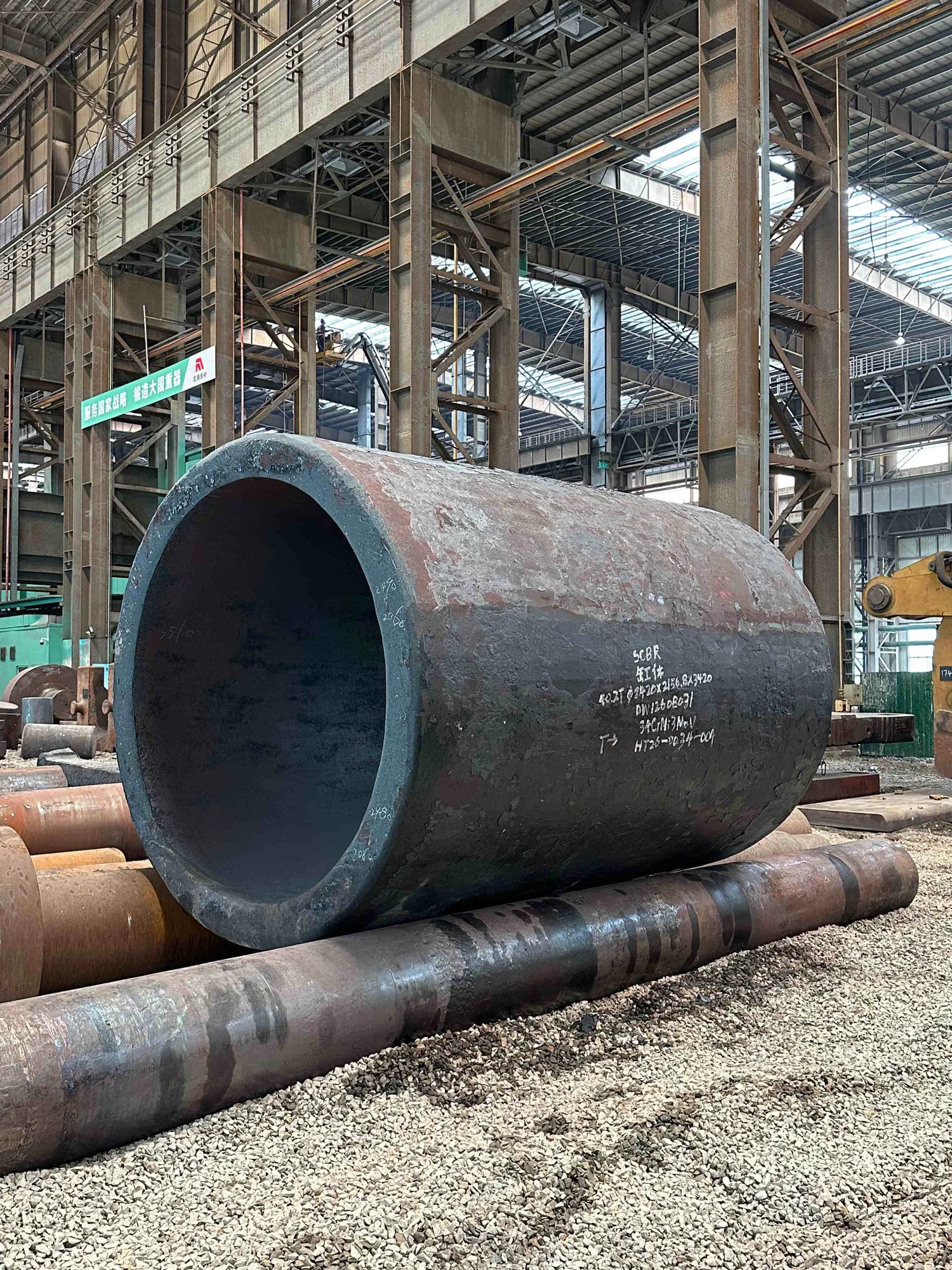
Seamless heavy cylindrical forgings up to Ø5.5 m and 300 t: reactor and vessel shells, barrel sections, sleeves and nozzles in alloy, Cr-Mo and stainless steel. Made from steel melted and vacuum degassed in-house, supplied as-forged, rough-machined or finish-machined to drawing.
 –>
 –>
Why forged shells instead of rolled-and-welded plate
A forged shell is seamless. Without a longitudinal weld, there is no seam to inspect, repair or monitor over the vessel’s service life, and the forged structure gives uniform mechanical properties through the full wall. Heavy wall thicknesses become possible beyond the practical limits of rolled plate.
For heavy-wall reactors and high-pressure vessels, large forged cylinders reduce welding, non-destructive testing and fabrication risk at the vessel shop, which often outweighs the higher material cost.
Applications
- Shells for hydroprocessing and other refinery reactors
- Heavy-wall pressure vessel and column shells
- Heat exchanger shells and channel barrels
- High-pressure gas storage sleeves
- Boiler and header sections, nozzles and connecting pipes
- Bearing sleeves and cylinders for heavy machinery
Size range and delivery conditions
- Outside diameter
- Up to 5.5 m
- Single weight
- Up to 300 t
- Length and wall thickness
- Depending on diameter and material
- As-forged
- For fabricators who machine in-house
- Rough-machined
- With machining allowance to your specification
- Finish-machined
- Bore, outside diameter, weld preparations and nozzle openings to drawing
Alloy, Cr-Mo and stainless steel shell forgings
- Carbon and C-Mn steels
- 16Mn · SA-266, SA-105 and EN equivalents
- Low-alloy and Cr-Mo steels
- 15CrMo · 12Cr2Mo1 · SA-336 F11 / F22 / F22V for high-temperature and hydrogen service
- Alloy steels for machinery
- 42CrMo4 · 34CrNiMo6
- Stainless steels
- 304 / 304L · 316 / 316L
Steel is melted in a 30 t electric arc furnace, ladle refined and vacuum degassed (VD/VOD) in-house. Protective-atmosphere electroslag remelting (PESR) is available for high-purity grades.
Heat treatment, testing and documentation
Long cylinders and tubes are heat treated vertically in a pit furnace up to Ø2.5 × 18 m, with water, oil and spray quenching, for uniform properties along the full length.
- Chemical analysis, ladle and product
- Tensile, impact (including low-temperature) and hardness testing
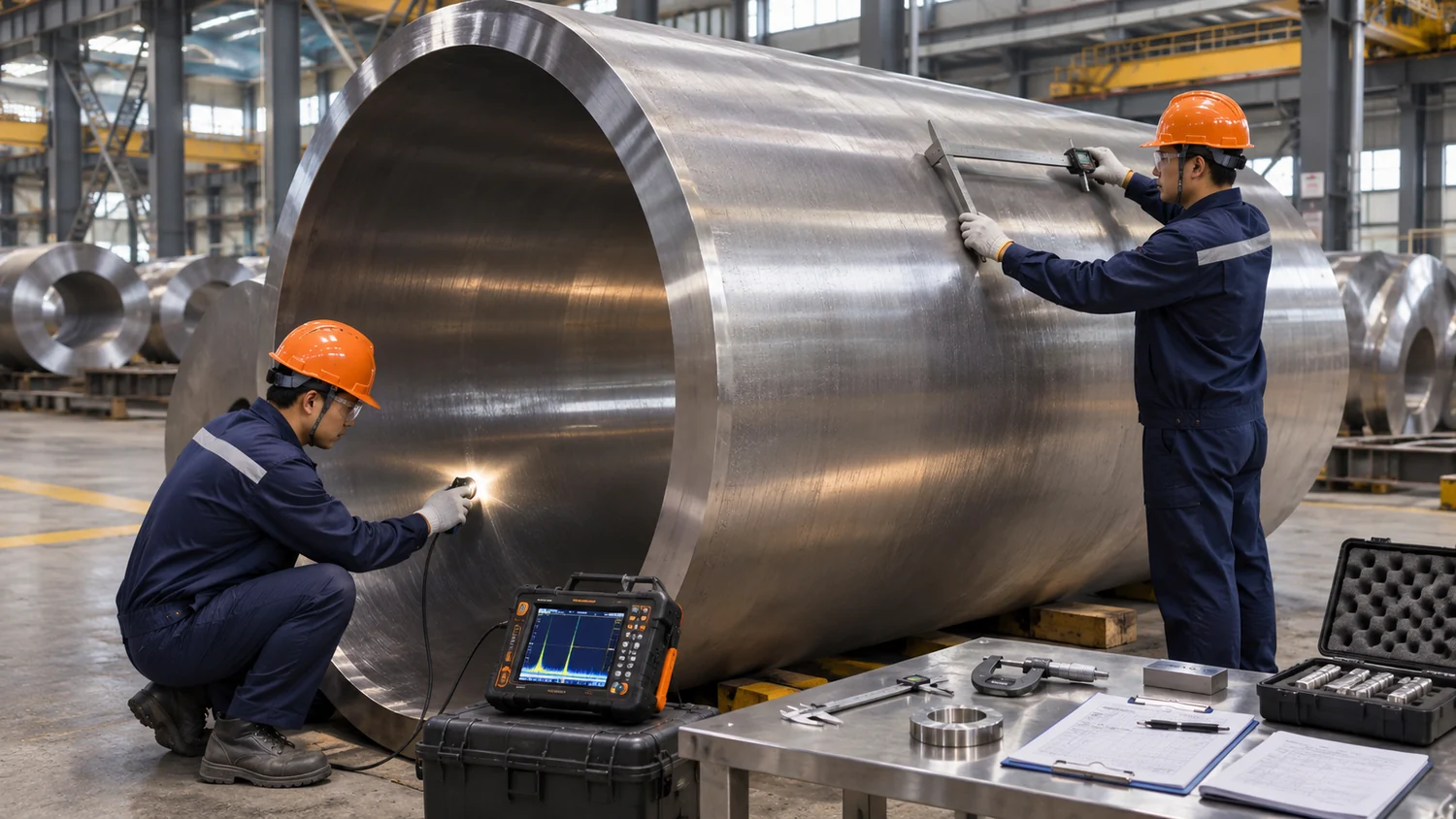
- Ultrasonic testing (UT) of the full volume
- Magnetic particle (MT) or liquid penetrant (PT) testing of machined surfaces
- Dimensional inspection report
- EN 10204 3.1 inspection certificate; 3.2 with third-party witness on request
- Material compliant with the EU Pressure Equipment Directive (PED), including AD 2000-W0
Why order your forged cylinders through HEAVY-FORGINGS.com
Sizes few forges can make
A 16,000 t press with GLAMA manipulator produces shells up to Ø5.5 m and 300 t.
Steel from the same group
In-house melting, refining and vacuum degassing give control over chemistry, cleanliness and traceability from melt to finished shell.
Pressure equipment documentation
PED-compliant material and 3.1 certificates, ready for your design and inspection file.
One European contact
REVROK handles technical clarification, quotation and order follow-up, from drawing to delivery.
Frequently asked questions
What is the difference between a forged shell and a rolled-and-welded shell?
A forged shell is seamless: it has no longitudinal weld, so there is no weld seam to inspect, repair or monitor in service. The forged structure gives uniform properties through the wall, and wall thicknesses are possible beyond the practical limits of rolled plate. For heavy-wall reactors and high-pressure vessels, this reduces welding, inspection and risk at the fabricator.
What is the maximum size of your forged cylinders?
Cylinder forgings are produced up to 5.5 m outside diameter and forgings up to 300 t single weight on the 16,000 t press. Length and wall thickness depend on diameter and material; send us your dimensions for a feasibility check.
Which materials do you supply for forged shells?
Carbon and carbon-manganese steels, low-alloy and Cr-Mo steels for high-temperature service, and stainless steels. Steel is melted, refined and vacuum degassed in-house, with electroslag remelting available for high-purity grades.
In which condition are forged cylinders delivered?
As-forged, rough-machined or finish-machined to drawing, after heat treatment. Long cylinders and tubes are heat treated vertically in a pit furnace up to Ø2.5 × 18 m.
What information do you need for a quotation?
Outside and inside diameter or wall thickness, length, material grade, design code, testing requirements, delivery condition, quantity and required delivery date. A drawing or sketch is ideal.
Request a quotation for forged cylinders and shells
Send your drawing and requirements. We reply within two working days with questions or a quotation.