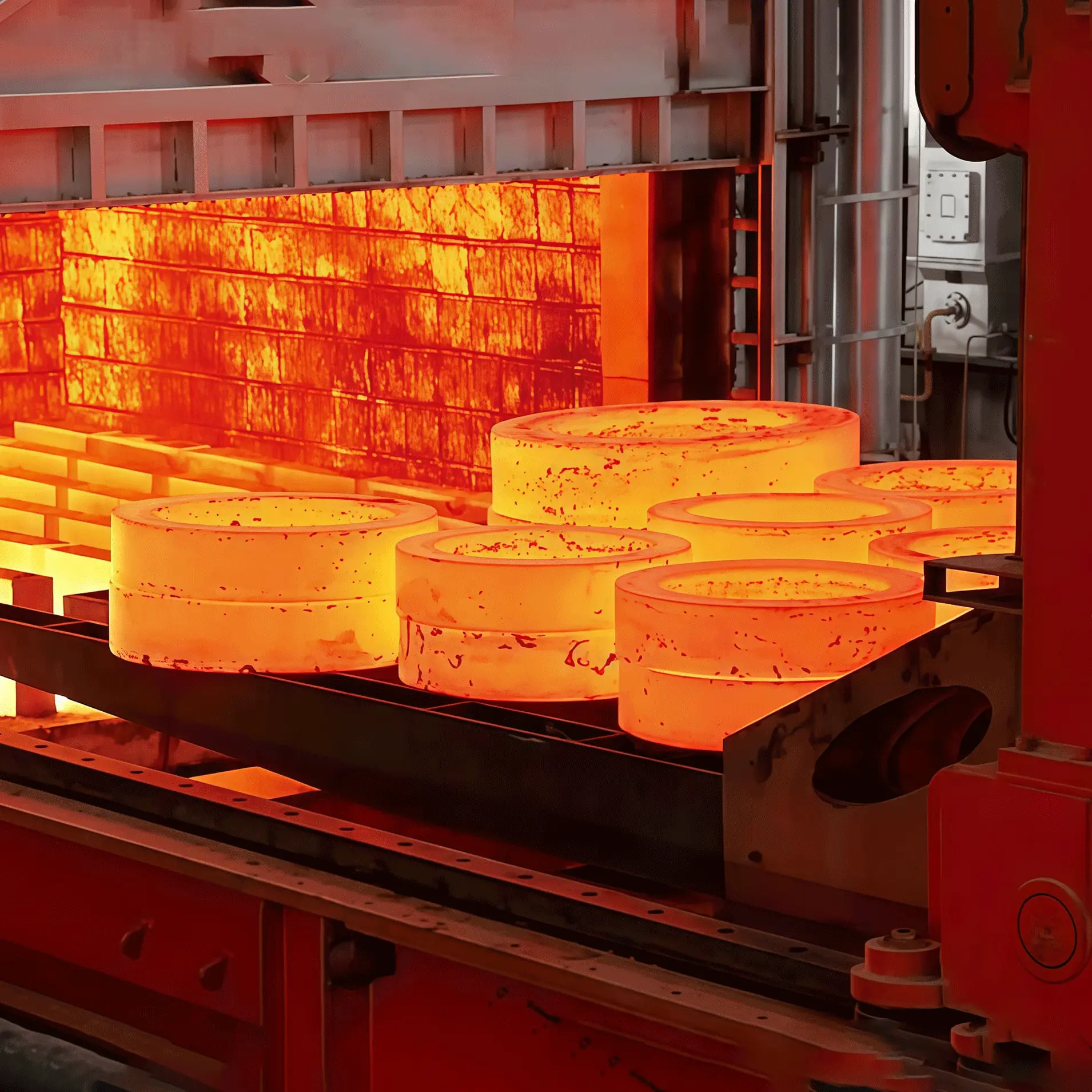
Excerpt: A new integrated manufacturing route combines steelmaking, secondary refining, very-heavy open-die forging, heat treatment and machining for critical industrial components up to the 300-tonne class.
New Integrated Heavy Forging Capability: 160 MN Press, Steelmaking and 300-Tonne-Class Forgings
The manufacture of very large forged components depends on considerably more than the size of a forging press.
For critical pressure equipment, petrochemical plants, marine engineering, power generation and heavy machinery, the complete manufacturing route matters: steelmaking, secondary metallurgy, ingot quality, forging, heat treatment, machining, inspection and final documentation.
A major expansion within Wuxi Hongda Heavy Industry’s manufacturing group now brings these processes together in a much more integrated heavy-forging route.
160 MN / 16,000-Tonne Open-Die Forging Press
At the centre of the new facility is a 160 MN — approximately 16,000-tonne — open-die hydraulic forging press.
The press is supported by a German forging manipulator for the controlled handling of very large workpieces during the forging process.
This substantially expands the range of components that can be considered, including:
- extra-large forged tube sheets;
- hydrogenation-reactor and pressure-vessel shell forgings;
- large discs and rings;
- marine and propulsion shafts;
- power-generation rotors;
- heavy machinery forgings;
- project-specific open-die forged components.
The new production route is intended for forgings in the very-heavy class, with project capability extending toward individual components of approximately 300 tonnes, depending on material, geometry, forging route, heat treatment, machining and inspection requirements.
Maximum dimensions and weight must therefore always be confirmed against the actual drawing and specification.
Integrated Steelmaking and Secondary Metallurgy
Perhaps the most significant development is not the forging press itself, but the addition of steelmaking.
The new manufacturing route integrates electric-furnace steelmaking with secondary refining and vacuum degassing before the forging operation.
This creates the possibility of controlling more of the material route from the initial melt through to the final forged component.
For critical heavy forgings, this can be important because final performance depends not only on deformation during forging but also on:
- chemical composition;
- steel cleanliness;
- dissolved gas levels;
- inclusion control;
- ingot quality;
- segregation;
- forging reduction;
- heat-treatment history;
- final mechanical properties.
For pressure-equipment, energy and heavy-engineering buyers, integrated control of the material and forging route can therefore be as important as maximum press capacity.
Large Component Capability
The expanded manufacturing route opens the possibility of evaluating very large forged components, including rings, discs, shells and shafts.
Current project-development capability includes components in the following dimensional classes:
- rings up to approximately Ø7.5 m;
- discs up to approximately Ø8.5 m;
- forged shells up to approximately Ø5.5 m;
- shafts up to approximately 26 m in length.
These values should be treated as manufacturing capability indicators rather than universal catalogue limits.
The actual maximum component depends on the selected material, starting ingot, section thickness, forging sequence, required mechanical properties, heat-treatment route and machining envelope.
Heat Treatment, Machining and Inspection
Producing a large forging is only the first stage.
Heavy-Forgings.com therefore evaluates projects around the complete downstream manufacturing route.
Hongda operates extensive heat-treatment and machining facilities together with non-destructive testing and laboratory capability.
Depending on the product and specification, forgings may be supplied:
- as-forged;
- rough-machined;
- finish-machined;
- drilled;
- clad or weld overlaid;
- inspected and documented according to the agreed project requirements.
Large tube-sheet drilling, heavy turning, boring, milling and shaft machining form an important part of the manufacturing capability.
Applications
The expanded capability is particularly relevant to industries where component integrity, material traceability and manufacturing scale are critical.
Typical applications include:
Pressure Equipment and Petrochemical
Large forged tube sheets, shells, flanges, reactor components and pressure-vessel forgings for refining, chemical processing, heat exchangers and high-pressure equipment.
Marine and Offshore
Large shafts, intermediate shafts, propulsion components, crankshafts and other critical marine forgings.
Power Generation
Heavy shafts, rotors, rings, discs and pressure components for thermal, hydroelectric and other power-generation applications.
Heavy Machinery
Large rings, shafts, gear blanks and customised open-die forgings for mining, metallurgy and heavy industrial equipment.
Material and Certification Requirements
Heavy forging projects should begin with the customer’s required material and specification rather than with a generic product catalogue.
Material families can include carbon steels, pressure-vessel steels, quenched-and-tempered alloy steels, stainless steels, duplex grades, nickel alloys and other specialised materials.
Depending on the application, certification and inspection requirements may include PED, EN 10204 documentation, API requirements, marine classification or project-specific third-party inspection.
The exact applicable scope should always be confirmed before manufacture.
Why the Integrated Route Matters
A 16,000-tonne forging press is impressive, but press size alone does not define manufacturing capability.
The more important question for an engineering or procurement organisation is:
Can the complete manufacturing route — from steelmaking through forging, heat treatment, machining, inspection and documentation — support the technical requirements of the component?
For very large and technically demanding forgings, that integrated capability can substantially reduce the interfaces between separate suppliers and provide a clearer route for material control and traceability.
Heavy-Forgings.com and REVROK coordinate the initial technical and commercial review of European and Middle East enquiries before the appropriate manufacturing route is developed.
Full Technical Capability Review
For detailed information on the 160 MN forging line, steelmaking, materials, machining, heat treatment, inspection, certification and product routes, see:
Heavy Forgings Technical Resources/heavy-forgings-technical-resources/
For a specific project, drawing or material requirement, use the Technical RFQ form on Heavy-Forgings.com.